
- Servicenow
What Is ServiceNow Process Mining and How It Works
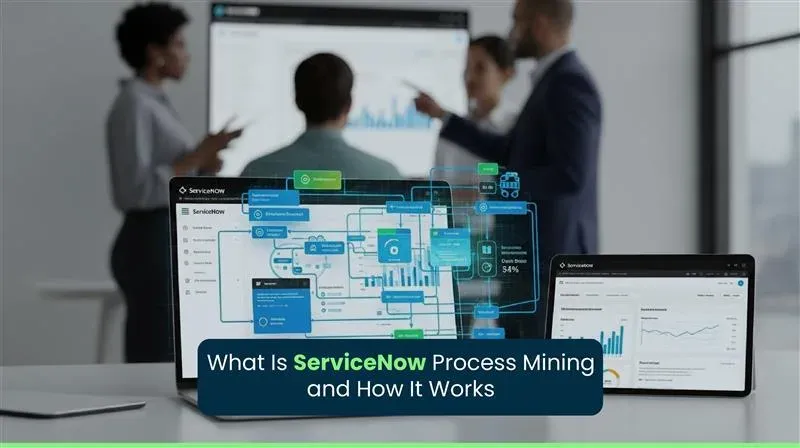
Whatever your organization or industry, you have workflows that keep things moving smoothly; the more efficient those processes are, the more productive your employees and systems may be. To increase productivity and revenue, assess and optimize your work procedures. What’s the challenge? It is to determine where and how to optimize your workflows. That’s where ServiceNow process mining comes into play.
Process mining is a powerful tool that enables businesses to extract log data from their information systems in order to better understand the performance of various processes. This enables them to optimize such processes using data-driven decision-making. Using these and other IT initiatives, you may be more deliberate about your organization and make every workflow as seamless as possible.
Let’s find out everything about process mining in this post.
ServiceNow Process Mining and Its Importance
ServiceNow Process Mining is software that allows enterprises to analyze and visualize their business processes using data from digital workflows. The software identifies process bottlenecks, inefficiencies, and compliance issues by giving precise process maps and performance measurements.
It enables users to compare current processes to desired workflows, highlighting variations and areas for improvement. ServiceNow Process Mining connects with current systems to collect event data, providing insight into the underlying causes of process delays and enabling data-driven decision-making. The program seeks to improve operations and support process transformation initiatives by providing actionable data on workflow execution across the company.
Some of the benefits of process mining are:
- Visualization of real-world operations
Gain total insight and understanding of process and task execution across ServiceNow and other applications.
- Identification of inefficiencies and conformity gaps
Obtain AI-generated improvement opportunities using Now. Assist in identifying and prioritizing AI agent and automation use cases.
- Turning thoughts into actions
Create and deploy AI agents and automation on a single platform to capitalize on improvement possibilities more quickly.
- Governing AI agents
Use real-world operational data to continuously improve agentic workflows and ensure compliance.
Why Process Mining is Important
Process mining is becoming an important business stage because the data it collects helps spot patterns, optimize performance, and generate valuable forecasts for the future. It can shorten the time it takes to complete specific processes, reduce expenses and investment amounts, minimize waste, and increase the overall quality of your operations, boosting your company’s competitiveness.
Leaders may make confident, objective budget and resource decisions by decreasing costs and eliminating inefficiencies in their operations through the use of data. It helps eliminate the guessing or subjective nature of human experience and creates adjustments based on factual knowledge.
How Process Mining Works
Every time an IT operation is performed, event log data is generated; in essence, this data serves as the primary means of documenting interactions between people and bots.
An event log might include any number of actions or occurrences that occur within a software system, and each log records specific information such as when the event occurred, what happened, and the method used to complete or accomplish that action. This could be a support ticket that a customer opened and has to be resolved, or it could be the processing of a recent online loan application. Whatever the occurrence, process mining analyzes event logs in real time to provide a snapshot of a system’s functionality.
Process mining enables digital transformation and automation in your business by uncovering bottlenecks in your workflows through the use of “screenshots” of your systems.
Stages of Process Mining
Here’s a closer look at each stage of the mining process.
- Data ingestion
When business transactions or things travel through your business process within a system, they create a digital footprint. These events are detected using process mining technology, which visually reconstructs the event logs to help users comprehend what happens from start to finish.
- Discovery
When data is precisely captured and visually rebuilt, a digital twin is formed, which is an interactive map of the chronological order of occurrences. This map shows all of the paths an event took to finish the process; each path is referred to as a variant, and variants that diverge from the conventional path are referred to as deviants.
- Analytics
Your process map results make it much easier to identify difficulties or hiccups, allowing you to determine the ideal workflow based on the process map. The process map assists in determining the fundamental causes of inefficiencies that are affecting cycle time, operational costs, and your bottom line.
- Benchmarking
You can also use process benchmarking to compare process performance across two dimensions, such as the time it takes to complete a purchase order from two distinct suppliers. This might help you make your operations more consistent or identify best practices for specific regions, departments, and so on.
- Checking for Conformance
Finally, you can use conformance testing to assist in specifying your desired path for specific processes and then track when they deviate. This is how you may examine the percentage of events that adhere to your desired procedure against those that do not, allowing you to enhance and optimize those processes.
Key Features of Process Mining
The main features of ServiceNow process mining are listed below:
- Automated process discovery: It ensures that process models are extracted from event logs efficiently.
- Conformance checking: It monitors deviations by comparing the process model to the logs.
- Social network/organizational mining: It identifies patterns and links between events inside your network/organization structures in order to improve tactics.
- Automated simulation model construction: It predicts how future trends or changes may affect your processes.
- Model extension: It provides flexibility in terms of existing models being extended or enhanced as new information is uncovered.
- Model repair: It uses conformance testing to filter out deviant behaviors in the model.
- Case prediction: It expects case outcomes utilizing key performance indicators and previously conducted sequences.
- History-based recommendations: It provides recommendations based on data collected and previous event records.
Process Mining Use Cases
Companies that utilize any repetitive digital process can benefit from process mining, and even those that do not now use such processes are likely to adopt the digital transformation era to stay competitive. However, process mining can be used to optimize operations in almost any business. Here are some instances.
- Finance
Whether you want to improve the efficiency or security of your loan application process, data mining allows you to respond faster to weaknesses in personal information and identify challenges for both customers and employees. It also aids in account auditing, customer acquisition, and other tasks.
- Auditing
Compliance is one of the most difficult tasks in running a corporation, and data mining can help maintain software compliance by detecting dangerous deviations.
- Software Development
Process mining allows for improving DevOps pipelines, keeping data moving where it needs to go, and producing high-quality software. It is especially effective for developing a well-documented process that allows IT administrators to guarantee that their systems and procedures are working properly.
- E-commerce
If you want to gain additional insights into buyer behavior to better understand your customer base, data mining can help you identify patterns and enhance sales.
- Logistics
Data mining helps keep the supply chain moving by processing thousands of data points from warehouses and identifying trends in warehouse performance.
Conclusion
ServiceNow process mining provides a powerful link between raw data and strategic decision-making. By transforming complex event logs into visual, actionable information, it enables businesses to identify inefficiencies, streamline operations, and continuously optimize their processes. Whether you work in banking, healthcare, education, or software development, the ability to monitor, benchmark, and improve workflows in real time provides your company with a competitive advantage. As digital transformation advances, process mining becomes not only advantageous but also necessary for driving operational excellence and data-driven innovation. To learn more about ServiceNow and its features, join NowTribe, the world’s largest ServiceNow community in the making. It offers a platform to ServiceNow professionals for shared learning and collaboration. ServiceNow professionals from across the globe can share insights and find opportunities to learn and grow. Join now!